
Magnetic Tiles for Family Game Night: Why Screen-Free Building Play Wins in 2026
It is 7 p.m. on a weekday. The tablet comes out, the room goes quiet, and another evening slips away. For many families this scene repeats four nights a week or more. The 2025 Common Sense Census found that 40% of children have their own tablet by age two, and tweens average about 5 hours 33 minutes of screen media every day.
Yet the same research points to a fix that does not require lectures or confiscation. It requires something worth reaching for instead. Magnetic tiles, with their satisfying click-and-snap build cycle, have quietly become the screen-free centerpiece of modern family game night. This guide explains why they work, what the research says about building play, and how to pick a set your kids will still be using years from now.
- Tweens now average 5.5 hours of daily screen media, so parents need engaging offline alternatives, not just rules (Common Sense Media, 2025).
- Block-building complexity at age 3 predicts spatial and math skills at ages 4 and 5 (Wolfgang et al., 2001).
- Look for strong internal magnets, at least 100 pieces, and drop-tested ABS plastic.
- A weekly game night ritual beats one-off attempts: same night, same hour, tiles already on the table.
Why Do Magnetic Tiles Pull Kids Away From Screens?
In 2025, Common Sense Media's census reported that tweens spend roughly 5 hours 33 minutes per day with screen media. Magnetic tiles compete with that because they solve the two problems screens exploit: instant feedback and zero setup cost. A tile snaps to another tile in under a second. There is no app to load and no instructions to read.
The click itself matters more than parents expect. Strong internal magnets give a physical reward every single time two pieces connect, which is the same dopamine loop a game uses, delivered in wood and plastic. Toddlers get the payoff. Eight-year-olds still get the payoff.
There is a second, quieter advantage: the topple. When a tower falls, nothing is lost. The pieces scatter, the child rebuilds, and the game continues. Screens rarely offer failure this forgiving, and that difference keeps frustration low enough for siblings of different ages to stay at the same table.
Open-endedness is the last piece of the puzzle. A tablet game has a designer's ceiling: levels end, content runs out. A 100-piece tile set has no ceiling. The same box that built a rainbow castle in March builds a marble run in October, which is why these sets tend to stay in rotation for years rather than weeks.
How Does Magnetic Building Play Support STEM Skills?
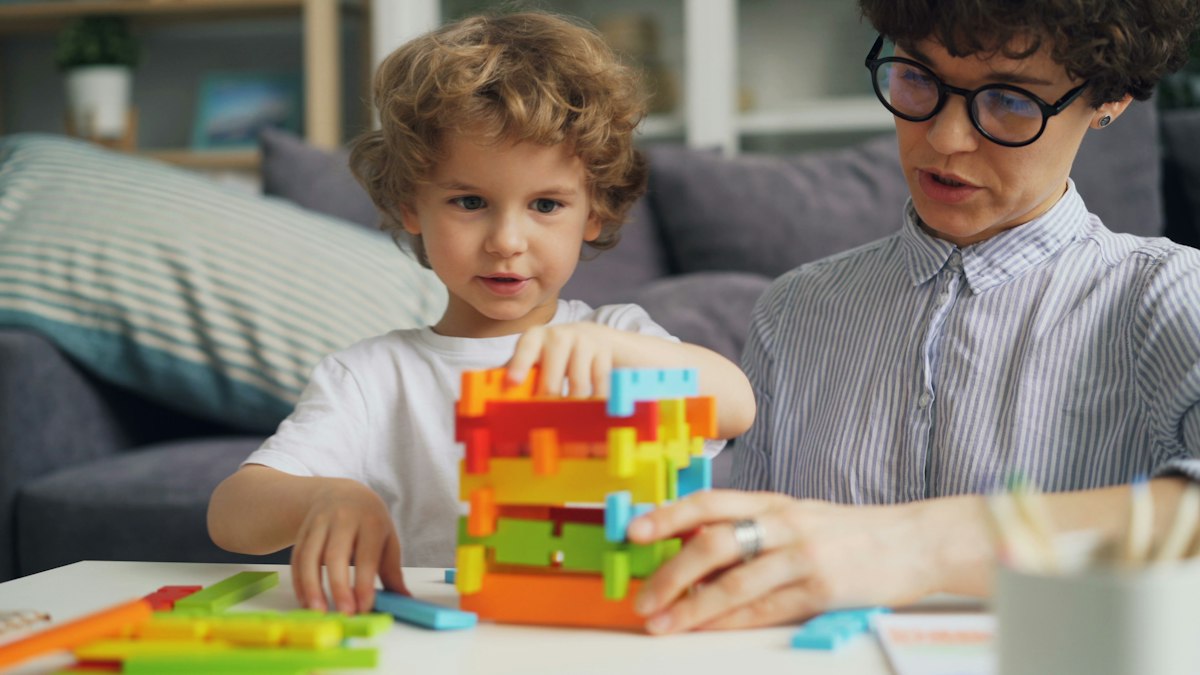
In 2001, researchers Wolfgang, Stannard, and Jones tracked preschoolers' block play and found that higher construction complexity predicted later mathematics achievement. Their work, published in the Journal of Research in Childhood Education, built on earlier findings that block building strengthens spatial skills that carry into science and engineering fields (Wai, Lubinski, and Benbow, 2009).
The reason is mechanical. To copy a model structure, a child must encode shapes, hold orientations in mind, and mentally rotate pieces before placing them. Those are precisely the skills researchers link to later STEM success. Magnetic tiles add a wrinkle plain blocks do not have: polarity. Tiles that repel teach cause and effect faster than any worksheet.
Research also shows the payoff arrives early. A study of 3-year-olds found block-building behaviors were associated with concurrent spatial skills, and structural complexity predicted both spatial and math skills at ages 4 and 5 (PMC7954229, 2020).
Parents do not need to teach any of this. A play guide with graduated prompts, from simple shapes to advanced 3D structures, lets the learning happen while the child believes they are just building a castle. That is the entire trick: skills arrive disguised as fun.
How Do You Plan a Family Game Night Everyone Joins?
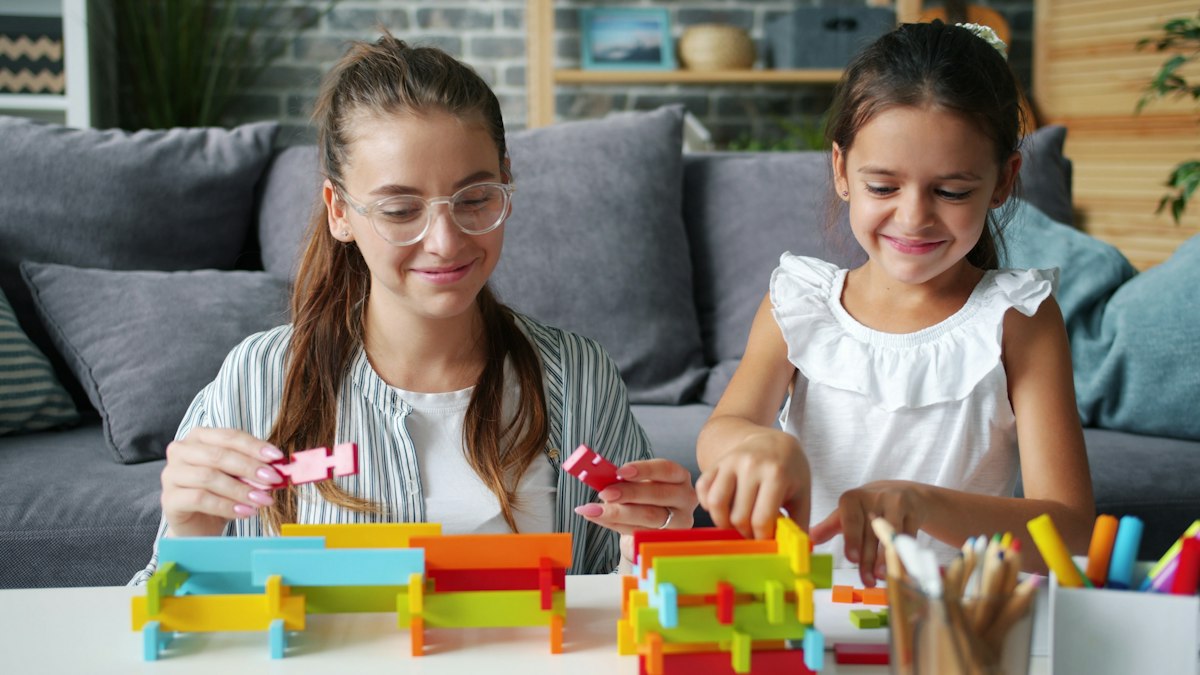
The families who sustain game nights treat them like dental appointments: fixed, recurring, non-negotiable. Pick one night, one start time, and a 45-minute window. Short beats ambitious. A child who knows tiles appear every Friday at 7 p.m. begins anticipating them, and anticipation is what replaces the tablet's pull.
Three steps make the first night work:
- Set the table before announcing it. Tiles already spread out halve the friction of starting.
- Give each person a role. One child sorts colors, one builds the base, parents add walls. Everyone contributes at their own skill level.
- End on a high note. Photograph the structure, then topple it together. Finishing while it is still fun guarantees a next time.
Families who try this consistently report one surprise: the parents get hooked too. Building a stable three-tile-wide tower is genuinely absorbing, and a parent absorbed in construction is a parent not checking their phone, which quietly doubles the effect for the children watching.
Keep the ritual screen-adjacent rather than screen-hostile. Do not frame game night as a punishment for screen time. Frame it as the highlight of the week, and let the tiles earn that reputation on their own.
What Should You Look for When Buying Magnetic Tiles?
Not all tile sets are equal, and the differences show up within minutes of play. Four criteria separate a set that lasts years from one that frustrates a child into abandoning it.
- Magnet strength. Weak magnets mean structures collapse under their own weight. Look for internal magnets that produce a confident snap and hold a vertical wall without sliding.
- Piece count. A 100-piece set supports solo play and sibling collaboration. Smaller sets run out of pieces exactly when a build gets interesting.
- Material durability. Drop-tested ABS plastic survives the build-and-topple cycle. Thin single-layer tiles crack at the corners after a few months of floor play.
- A graduated play guide. Prompts that scale from easy to advanced extend the set's lifespan and quietly deliver the structured-play benefits research highlights.
Safety note for younger children: sealed internal magnets are the standard design, and reputable sets ultrasonically weld the halves so magnets cannot escape. Check the seam quality before handing tiles to a toddler.
One Set That Checks Every Box
Our best-selling toy of the past year is the StoreClaw Magnetic Tile Puzzle for Family Game Night, and it tops the chart for reasons that map directly onto the checklist above.
The set offers strong internal magnets for a confident snap, a 100-piece count that supports both solo builders and sibling teams, a STEM-aligned play guide that scales from easy to advanced prompts, and drop-tested ABS plastic built to survive years of the build-and-topple cycle. It comes in Standard and Deluxe sets with Multicolor or Pastel Mix palettes, priced from $35.95 to $43.86.
Pull the whole family away from the screens tonight. The set that clicks, holds, and keeps them building.
Shop the Magnetic Tile PuzzleFrequently Asked Questions
What age are magnetic tiles best for?
Most families start between ages 3 and 10. Research on 3-year-olds found block-building complexity predicted spatial and math skills at ages 4 and 5, so earlier play compounds (PMC7954229, 2020). Younger toddlers can join with supervision given sealed internal magnets.
How many tiles does one child need?
A 100-piece set is the practical floor. Smaller sets run out mid-build, which cuts play sessions short. With two children, 100 pieces supports collaboration without forcing competition for scarce shapes.
Are magnetic tiles actually educational, or just a toy?
They are both. A randomized controlled trial of block play with preschoolers improved numeracy, shape recognition, and math language skills (Schmitt et al., 2018). The learning arrives through play, not drills.
How do I keep tiles engaging after the first month?
Rotate challenges instead of rotating toys. A play guide with graduated prompts, from copying simple shapes to advanced 3D designs, renews interest. Structured block play, where kids copy a model, delivers the strongest spatial-skill benefits researchers have measured.
Do magnetic tiles replace screens entirely?
No single toy does. But tweens average about 5 hours 33 minutes of daily screen media (Common Sense Media, 2025), and a weekly building ritual reclaims a meaningful slice of that time while training skills screens do not.
Conclusion
Family game night does not need to win a war against screens. It needs to win one evening per week. Magnetic tiles do that job because they match what screens offer: instant feedback, escalating challenge, and endless novelty, all delivered through hands that build instead of scroll.
- Start with one fixed night and a 45-minute window.
- Choose a set with strong magnets, 100+ pieces, and a graduated play guide.
- Let the research be your backup: block play at 3 predicts math skills at 5.
The tiles go on the table Friday night. The tablet stays on the counter. That is the whole strategy, and it works.
1. Common Sense Media — "The Common Sense Census: Media Use by Kids Zero to Eight, 2025", retrieved 2026-09-24, https://www.commonsensemedia.org/research/the-common-sense-census-media-use-by-kids-zero-to-eight-2025
2. PMC / Frontiers — "Associations of 3-year-olds' block-building complexity with later spatial and mathematical skills", retrieved 2026-09-24, https://pmc.ncbi.nlm.nih.gov/articles/PMC7954229/
3. Schmitt, S.A. et al. — "Using block play to enhance preschool children's mathematics and executive functioning: A randomized controlled trial", Early Childhood Research Quarterly, 2018, https://doi.org/10.1016/j.ecresq.2018.04.006
4. Wai, J., Lubinski, D., & Benbow, C.P. — "Spatial ability for STEM domains: Aligning over 50 years of cumulative psychological knowledge solidifies its importance", Journal of Educational Psychology, 2009, https://doi.org/10.1037/a0016127