
Why Magnetic Tiles Win Every Family Game Night
Family game night is a staple in most homes: 82% of Americans have family game nights, and nearly nine in ten planned to continue the tradition in 2023 (PuzzleSnap, Family Time Survey 2023). But keeping everyone engaged gets harder when one child outgrows a game, another cannot read the cards yet, and a tablet sits within arm's reach.
One toy category quietly solves all three problems: magnetic tiles. This guide explains why they hold attention across ages, what to look for when buying, and how to turn one set into a full evening of games for the whole family.
- 82% of Americans hold family game nights; magnetic tiles work for ages 3 to adult in one sitting (PuzzleSnap, 2023).
- Strong magnets and 100+ pieces separate a set that lasts years from one abandoned in a week.
- Construction play builds spatial skills that predict later STEM achievement (Frontiers in Psychology, 2023).
- One set, five game formats: patterns, towers, cooperative builds, and storytelling.
Why Do Magnetic Tiles Beat Screens on Family Game Night?
In 2025, Common Sense Media's Census of kids zero to eight found children average about two and a half hours of screen media per day (Common Sense Media, 2025). A toy that pulls a child away from that screen for a full hour is rare, and magnetic tiles do it because the play itself is satisfying: every connection clicks, every tower wobbles, and every collapse invites a rebuild.
Screens offer passive rewards. Tiles offer visible cause and effect. A child who watches a structure fall learns instantly what a weak base means. That feedback loop is the reason kids stay at the table longer than with most toys.
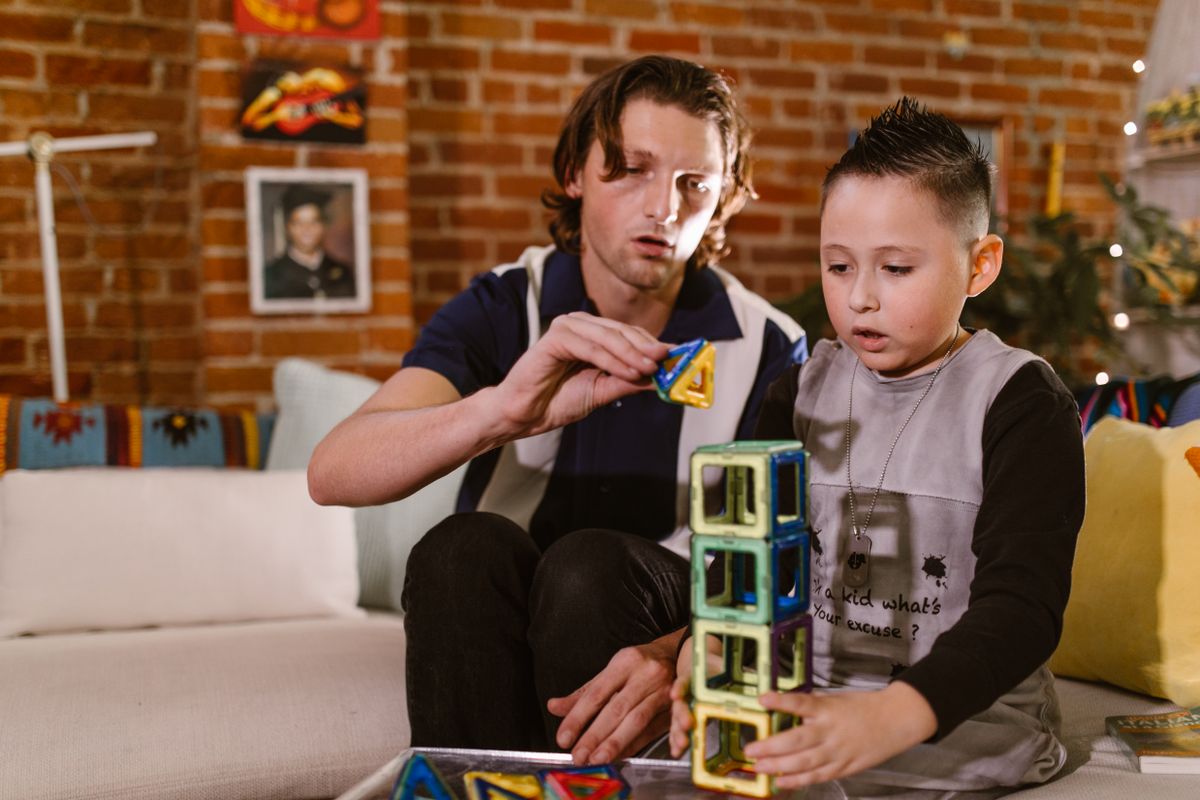
There is a practical reason parents keep buying magnetic tiles for game night specifically. Unlike board games, the difficulty scales itself: a four-year-old makes flat patterns, an eight-year-old builds castles, and a parent adds engineering ideas. Nobody has to lose for the game to end.
What Makes a Great Magnetic Tile Set?
Research on construction toys shows that building play predicts achievement in STEAM disciplines (Frontiers in Psychology, Malleability of Spatial Skills, 2023). But not every set delivers that benefit equally. Four criteria separate the good from the disappointing.
- Magnet strength. Weak magnets mean structures collapse under their own weight, which frustrates young builders fast. Look for sets described as holding firm through build-and-topple cycles.
- Piece count. A 100-piece set is the practical floor for family play: enough for solo builds and sibling collaborations without constant tile negotiation.
- Material safety. Drop-tested ABS plastic with sealed internal magnets is the standard to expect. Sealed magnets matter because loose magnets are the one real safety risk in this toy category.
- Play guidance. A STEM-aligned play guide with prompts that progress from simple to complex extends the usable life of the set by years.
Five Ways to Play: From First Patterns to 3D Castles
A single 100-piece set supports at least five distinct game formats, each suited to a different age or mood. This is why magnetic tiles earn their place on game night rotation while single-purpose toys drift to the bottom of the toy bin.
1. Pattern Match (ages 3-5)
One player builds a flat geometric pattern; the others copy it from memory. This is the training-wheels format, and it quietly teaches shape names and symmetry.
2. Tower Race (ages 5-8)
Each player or team gets half the tiles. Tallest freestanding tower in five minutes wins. The wobble factor keeps it exciting, and the inevitable collapse is half the fun.
3. Cooperative Castle (ages 6+)
Everyone builds one shared structure with a rule: each player adds exactly one tile per turn. The game ends when the castle stands for ten full seconds.
4. Symmetry Challenge (ages 7+)
Build a shape, then build its mirror image. This one maps directly to the spatial skills research links to later mathematics achievement.
5. Story Builder (all ages)
Build the setting for a story, then take turns telling it: a space station, an animal shelter, a castle under siege. The tiles become the stage, and every player adds a room.

Standard or Deluxe? Choosing the Right Set
The StoreClaw Magnetic Tile Puzzle for Family Game Night comes in two sizes and two colorways, and the choice is simpler than it looks. Families with one child under six can start with the Standard Set in Multicolor: the bright classic palette reads clearly during pattern games, and the piece count covers all five formats above.
Our top-selling game night pick: the StoreClaw Magnetic Tile Puzzle for Family Game Night, from Wonder Bright Kids. Strong internal magnets, a 100-piece set, a STEM-aligned play guide, and drop-tested ABS plastic, from $35.95.
See the Magnetic Tile PuzzleChoose the Deluxe Set if two or more children will build at once, or if the Pastel Mix palette fits your playroom. Deliberately mixing palettes across sets also unlocks color-sorting games, a bonus format that toddlers enjoy before they can build vertically.
Prices reflect the store listing at the time of writing and may change with promotions.
How Do You Plan a Magnetic Tile Game Night?
Keep the evening to three phases and under ninety minutes: a warm-up pattern round for the youngest players, one competitive build such as Tower Race, and one cooperative finale like the Cooperative Castle. Ending cooperatively matters. It sends everyone to bed having built something together rather than arguing over a scorecard.
Two practical tips from families who run these nights weekly: keep the tiles in a single shallow bin so setup takes under a minute, and photograph the final structure before cleanup. The photo album becomes the family's build history, and kids ask to outbuild last week's entry.
Frequently Asked Questions
What age are magnetic tiles best for?
Most sets, including ours, are rated for ages 3 and up. In a 2023 review of construction toy research, building play supported spatial skill development from preschool through elementary ages (Frontiers in Psychology, 2023), so the same set grows with a child for years.
Are the magnets safe for young children?
Yes, when the tiles use sealed internal magnets and drop-tested ABS housing. The tiles in our set are ultrasonically sealed, so the magnets stay inside even when a tower hits the floor. Always check that a set lists sealed magnets before buying for children under five.
How many pieces do I need?
100 pieces is the practical starting point for family play, and it is what our Standard Set includes. A 2023 review found construction play benefits scale with open-ended combinations (Frontiers in Psychology, 2023), so more pieces mean more build formats rather than diminishing returns.
Do magnetic tiles work with other brands?
Most magnetic tile brands use the same standard tile dimensions, so sets generally connect across brands. Mixing brands works best for free building; for pattern-matching games, matching colors and shapes within one set keeps the rules clean.
How do I clean magnetic tiles?
Wipe with a damp cloth and mild soap, then dry immediately. Avoid submerging the tiles: the seams around sealed magnets are water-resistant, not waterproof, and long soaks can weaken the housing over time.
Conclusion
Magnetic tiles earn their game-night spot because they solve the three problems that end most family game nights early: mixed ages, uneven skill levels, and the pull of screens. One 100-piece set covers five game formats, builds skills that research links to later STEM achievement, and keeps parents at the table too.
If your rotation needs a game the whole family can play tonight, the StoreClaw Magnetic Tile Puzzle for Family Game Night is our best-selling pick for a reason.
1. PuzzleSnap, "Family Time Survey 2023", retrieved 2026-09-24, https://puzzlesnap.com/blog/family-time-2023
2. Common Sense Media, "The 2025 Common Sense Census: Media Use by Kids Zero to Eight", retrieved 2026-09-24, https://www.commonsensemedia.org/research/the-2025-common-sense-census-media-use-by-kids-zero-to-eight
3. Frontiers in Psychology (PMC10523793), "Malleability of spatial skills: bridging developmental psychology and toy design for joyful STEAM development", retrieved 2026-09-24, https://pmc.ncbi.nlm.nih.gov/articles/PMC10523793/